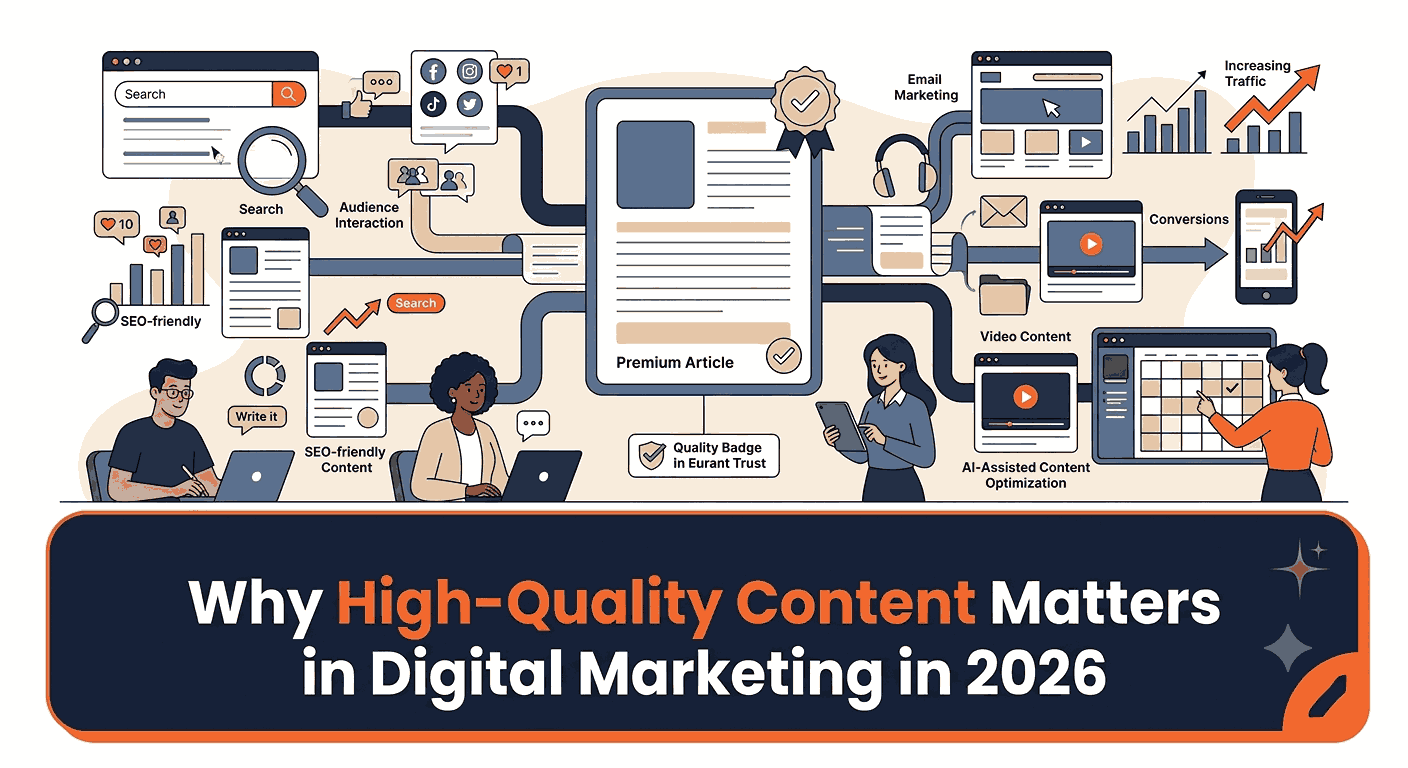
Publishing more content used to be enough. Fill a blog, post regularly, stay visible. That approach has stopped working. Search engines have become better at identifying what is genuinely useful and what is simply taking up space. Audiences have become better at recognising the difference too. The brands that are building real digital presence in 2026 are the ones investing in high-quality content rather than chasing volume.
What Makes Content High Quality?
High-quality content is not about word count or keyword density. It is about whether the content actually helps the person reading it.
The characteristics that define quality content:
- Relevance: Speaks directly to what the audience is searching for
- Accuracy: Every claim holds up and is supported where it needs to be
- Originality: Adds a perspective or explanation that is not already everywhere online
- Readability: Structured in a way that is easy to follow and scan
- Intent match: The format suits what the reader actually expects to find
- Usefulness: The reader walks away with something they did not have before
Content that gets these things right works for both the audience and the brand. Content that misses them wastes every hour spent creating it.
The Importance of High-Quality Content in Digital Marketing
Creating high-quality content in digital marketing matters far more than most brands realise. It is not just about where a page ranks. Content is how brands communicate, build trust, and move audiences from first impression toward a real decision.
Audiences who find genuinely helpful content are more likely to stay on a page, share it, return to the website, and trust the brand behind it. Businesses that publish frequently but without depth often build traffic without building trust. That gap between visitors and customers is usually a content quality problem.
Quality content supports multiple marketing goals simultaneously:
- It builds credibility with new audiences who are discovering the brand.
- It keeps existing customers engaged and informed
- It supports paid campaigns by giving audiences something worth landing on.
- It generates organic visibility without ongoing ad spend.
- It gives sales teams useful material to share in conversations.
Volume alone cannot achieve any of these things consistently.
Why Quality Content Is Important for SEO
Why quality content is important for SEO comes down to what search engines are actually trying to do. Google and other search engines exist to give users the most helpful answer to their query. Content that genuinely serves that purpose is more likely to appear in relevant searches.
Understanding how quality content improves search rankings requires looking at several connected factors, not one simple mechanism. It works through a combination of factors. Content that answers questions clearly tends to earn more time on page. Original, accurate content tends to earn more links and mentions. Content that matches search intent tends to satisfy users rather than sending them back to the results page.
None of these guarantee a specific ranking. But consistently producing content that performs well across all of these dimensions creates a stronger foundation than publishing frequently without those qualities in place.
Also read related article:
How to write search engine optimized content?
How Content Quality Affects Google Rankings
How content quality affects Google rankings has become a more visible conversation since Google began updating its guidance around helpful content. The core principle is clear. Content created primarily for people, not search engines, tends to perform better over time.
Factors that can support content quality from a search perspective include:
- Covering a topic thoroughly enough to satisfy the query genuinely
- Providing original analysis or perspective rather than restating what is already published
- Structuring information so it is easy to navigate and understand
- Keeping information accurate and updated when circumstances change
- Writing for the person searching rather than optimising for a specific keyword count
Content that performs well on these measures is more likely to hold its position than content built around tactics alone.
How to Create High-Quality Content in 2026
Knowing how to create high-quality content in 2026 starts with accepting that useful content takes more time than most brands currently allow. Before writing anything, understand what the reader wants. A skincare brand writing about "best moisturiser for dry skin" needs to answer that question well, not just repeat the phrase.
Research the topic, add a perspective that isn't already everywhere, and cut anything that doesn't serve the reader. A fitness brand that shares real workout results will always outperform one that copies generic advice. Keep content current as things change and optimize in a natural way, not in a mechanical way.
Content Marketing Trends in 2026
Two things shape content marketing trends in 2026 above all else. AI tools have made it easier to produce content quickly, but that has also flooded the market with generic material. Original, well-researched content stands out more than ever because audiences and search engines are getting better at telling the difference.
A travel brand publishing a detailed first-hand guide to visiting Rajasthan will consistently outperform one publishing a generic AI-generated article on the same topic.
- Video and audio content should complement written material rather than replace it.
- More in-depth coverage of topics with real depth.
- Content based on real experience, not just general overviews.
- Audiences demand more accuracy and transparency from brands.
Also read related article: Top Hacks to Scale Your Content Marketing Strategy
How to Create Content for AI Search
Understanding how to create content for AI search is becoming essential as AI-powered results take up more space on search pages. The rules are not completely different, but a few things carry more weight now.
- Answer the question early, not after three paragraphs of build-up
- Use clear headings and logical structure so content is easy to read
- Cover the topic properly because shallow content rarely gets treated as reliable
- Keep everything factually accurate since unsupported claims damage credibility quickly
- Show real knowledge and experience because AI systems recognise genuine expertise
No tactic guarantees AI search visibility. Brands that consistently meet these standards are better positioned than those still using outdated approaches.
The Role of E-E-A-T in Content Quality
E-E-A-T is not a complicated concept. It stands for Experience, Expertise, Authoritativeness, and Trustworthiness, and Google uses all four to decide whether content is worth showing to users.
- Experience: The person behind the content has real, first-hand knowledge of what they are writing about
- Expertise: They know the subject properly, not just well enough to sound convincing
- Authoritativeness: The brand or author is genuinely recognised as a credible voice in that space
- Trustworthiness: The information is honest, accurate and something a reader can actually rely on
Here is a simple way to think about it. A nutritionist writing about meal planning will always carry more weight than a generic article with no clear author. E-E-A-T is what separates content people trust from content that fills a page.
Also read related article: Perfect Sign of Best Content Writing Company
Conclusion
The brands that win online in 2026 are not the ones publishing the most. They are the ones publishing content that actually means something to the people reading it. High-quality content builds trust, earns visibility, and moves audiences toward decisions in ways volume never will. Get that right and everything else in digital marketing becomes easier. That is not a trend. That is just how it works.
Frequently Asked Questions
1. What makes content high quality?
High-quality content helps readers in a real, practical way. Accuracy, relevance, originality and readability all matter. The simplest test is whether someone finishes reading and actually learns something useful they didn't know before.
2. Does content quality affect Google rankings?
Yes, and the connection is real. Content that matches search intent, holds attention and earns links over time will always outperform content published frequently with nothing useful to say.
3. How can businesses create content for AI search?
Answer the question at the top, not in three paragraphs. Keep the structure clean and back every claim with real knowledge. AI systems are designed to find content that is factually reliable and easy to follow, not content stuffed with repeated keywords that adds nothing of value.
4. What role does E-E-A-T play in content quality?
E-E-A-T is how Google tries to answer one basic question: does this content come from someone who actually knows their subject? Experience, Expertise, Authoritativeness and Trustworthiness are the four things it looks at to tell the difference between genuine knowledge and a generic article that adds nothing new.
5. How is AI changing content marketing in 2026?
It’s easy to produce generic content at scale with AI tools, and the market is saturated with it. Original, well-researched material now stands out more because there is less of it. AI search is also pushing clarity, accuracy and genuine expertise to the front over anything keyword-heavy with no real value behind it.


