Ask a founder from the 1990s how they'd launch a product, and the answer would probably involve a print ad, a radio spot, or maybe a booth at a trade show. Ask a founder today, and you'll likely hear about A/B tests, retention curves, and CAC-to-LTV ratios. Something clearly shifted in between, and the shift is exactly why Growth Marketing vs Traditional Marketing keeps showing up in founder Slack channels, startup podcasts, and investor decks.
This isn't a matter of one method being "old" and the other being "new" for the sake of novelty. The two approaches solve for different problems, and knowing which one fits your business at a given stage can save serious money. Below, we'll unpack what actually separates them, why so many early-stage companies have moved away from broadcast-style advertising, and what a smarter, blended approach can look like for entrepreneurs building on a budget.
Traditional Marketing, in Plain Terms
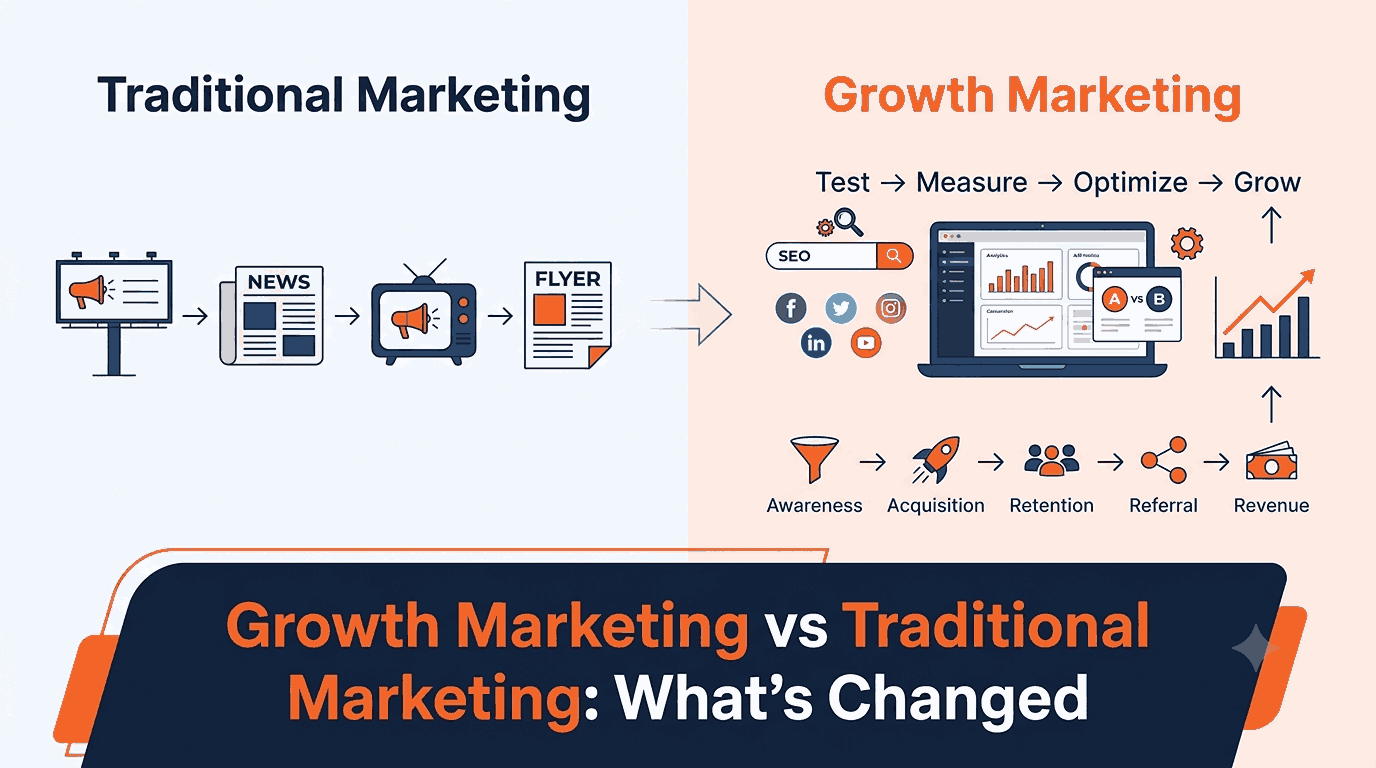
Traditional marketing covers the outbound channels most of us grew up with: TV commercials, billboards, newspaper ads, radio spots, cold outreach, direct mail. The underlying idea was reach. Put your message in front of enough eyeballs, and a percentage will eventually buy. Nothing wrong with that logic in an era where three TV networks and a local paper controlled most of a city's attention.
But that era is gone. Campaigns built on this model still get planned months out, locked into a fixed budget, and judged weeks or quarters later once the results trickle in. There's no live feedback loop. Once the ad runs, it runs. You find out if it worked after the money's already spent.
So What Is Growth Marketing, Exactly?
Growth marketing takes the opposite stance. Rather than broadcasting a message and hoping, growth teams treat almost everything as a live experiment: headlines, landing page layouts, checkout flows, even onboarding emails get tested against real user behavior. If something isn't converting, it gets changed within days, not quarters.
What makes a solid growth marketing strategy different from a one-off campaign is that it doesn't stop at the sale. It follows the customer through onboarding, into retention, and eventually toward referrals. A new customer is really just the starting point. The real value shows up later, when they stick around, upgrade, or tell a friend.
Also read related article: How Delhi Businesses Are Scaling Faster with Digital Marketing in 2026
Where the Two Actually Diverge
Put side by side, the differences aren't subtle:
- Traditional campaigns need weeks to show any signal. Growth experiments often surface results in a matter of days.
- A billboard or a TV slot costs the same whether it performs or flops. Growth channels let you start small, kill what fails fast, and pour more into whatever's actually working.
- Broadcast ads hit a wide, mostly unsegmented crowd. Growth campaigns are focused on specific behaviors and buying stages.
- Brand recall surveys and vague "reach" numbers dominate traditional reporting. Growth marketing tracks hard numbers: conversion rate, churn, lifetime value.
- Print doesn't bend. Once it's published, it's published. A digital campaign can be paused or rewritten the moment the data says so.
None of this means traditional advertising is useless. Still, it does explain why Growth Marketing vs Traditional Marketing has become less of an academic comparison and more of a real budgeting decision for founders with limited runway.
Why Startups Keep Leaning Toward Growth
Early-stage companies rarely have the cash reserves to gamble on a campaign that only proves itself after three months. That reality alone pushes most of them toward a growth-first approach, for a few practical reasons.
- Every dollar has to justify itself, and growth channels are far easier to track down to the rupee.
- Product-market fit is often still shaky in the early days, so quick testing tells you what's resonating before you scale spend behind it.
- Markets move fast, and locking into a fixed quarterly plan can leave you stuck while competitors adjust in real time.
Think about it this way: a founder running a Meta ad set can shut it down the moment it underperforms. Compare that to a direct mail campaign already sitting in ten thousand mailboxes. There's no pulling that back.
Also read the article blog: How Delhi Businesses Are Scaling Faster with Digital Marketing in 2026
Inside the Growth Marketing Funnel
Most growth strategies are built around a framework called the growth marketing funnel, which behaves less like a straight line and more like a loop. Traditional funnels tend to end at the sale. This one keeps going.
- Awareness: getting noticed by the right people, not just a lot of people
- Acquisition: turning that attention into a signup, a trial, or a first order
- Activation: so new users hit the "aha" moment fast enough that they don't wander off
- Retention: holding their interest through emails, product updates, or the occasional small nudge
- Referral: happy customers doing the selling for you, without being asked
- Revenue: growing the relationship through upgrades, add-ons, or cross-sells
Data from each stage loops back into earlier ones. That feedback loop is a big part of why growth-driven companies tend to scale faster than businesses relying purely on outbound ads.
Digital Marketing vs Traditional Marketing: Follow the Budget
There's an overlapping debate here too, and it's worth untangling. Digital marketing vs traditional marketing is often used almost interchangeably with the growth conversation, since most growth tactics live online. SEO, paid social, influencer partnerships, email sequences, all of it falls under digital marketing, and all of it offers far more control than a TV slot ever could.
Here's the catch, though: digital doesn't automatically mean growth-minded. A brand can run digital ads with the exact same broadcast mentality as an old print campaign, pushing one generic message to a huge audience with zero testing. What actually separates growth marketing from traditional marketing isn't the channel. It's the mindset. Digital simply makes rapid testing possible, but the philosophy behind it is what really counts.
Also read the related article: Should You Hire an Agency or Do Marketing Yourself?
Modern Marketing Strategies Worth Adopting
For founders trying to build something that holds up over time, a mix of proven tactics usually beats betting everything on one channel. A handful of modern marketing strategies that tend to pay off:
- Building content around actual search intent instead of publishing blog posts for the sake of it
- Running cheap A/B tests before committing real budget to a full campaign
- Personalizing email and retargeting sequences using real customer data
- Working with micro-influencers whose audiences are small but genuinely engaged
- Setting up referral or affiliate programs so existing customers become a growth channel on their own
None of these require the massive budgets that old-school advertising demanded. What they need instead is consistency, a willingness to measure results honestly, and the discipline to change course when something clearly isn't working.
How To Differentiate Between Different Practices?
Some established brands still get real value from traditional marketing, especially when the goal is broad awareness or reaching audiences that are harder to find online, older demographics in certain markets, for instance. But for most startups and growing businesses, the scale tips toward growth marketing, mainly because it offers faster feedback, tighter accountability, and better use of a limited budget.
Companies that win over the long run tend to treat marketing less like a campaign with a start and end date, and more like a system they keep refining. Test, measure, adjust, repeat. That compounding habit builds an edge that a single polished ad, however well produced, just can't replicate.
Where This Leaves Entrepreneurs
At its core, the debate over Growth Marketing vs Traditional Marketing comes down to how a business wants to learn about its own customers. Traditional marketing waits for the audience to respond to broad exposure. Growth marketing goes to where customers already are and keeps adjusting based on what the numbers actually show. For founders building something new, that kind of adaptability isn't a nice-to-have. Most of the time, it's the difference between a marketing budget that quietly disappears and one that builds a business capable of growing on its own steam.
Also read related blog: Why Every Global Brand Is Investing in India's Digital Market


