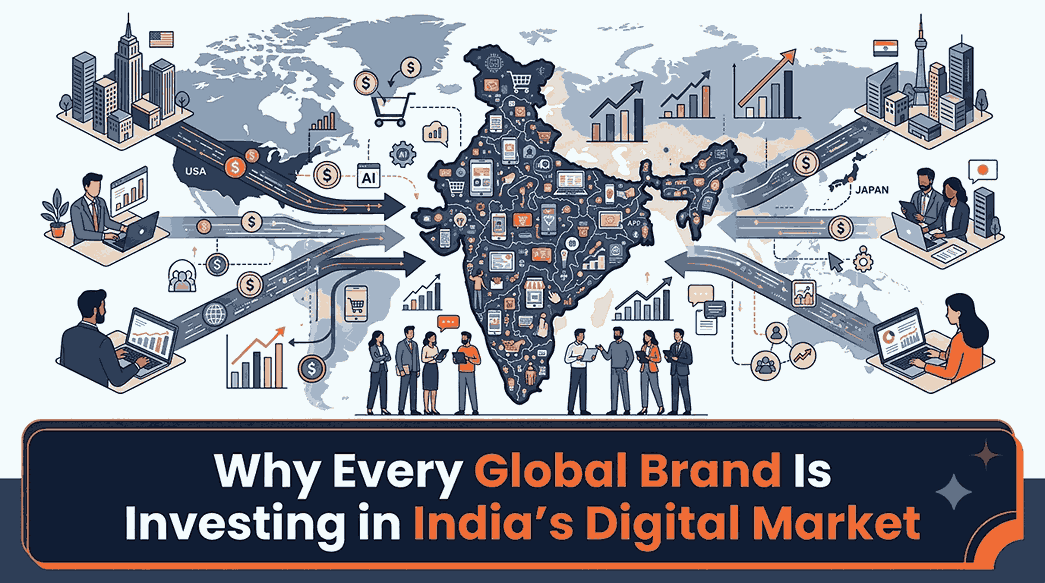
If we talk about a few years back, then India was somewhere at the bottom of global expansion decks. It isn’t the same anymore. Growth arrived faster than the five-year plans accounted for, and the digital market in India has outgrown the category of promising and slow-moving opportunity.
The question multinational retailers and technology firms are asking has shifted too. It's less about whether to enter and more about how fast a real presence can be built before someone else locks in the advantage of getting there first.
A Market Too Large to Ignore
India now counts among the largest internet populations anywhere, and most of that activity happens on a phone rather than a desktop. That one detail changes almost every decision a brand has to make when it enters the country.
A few changes that have come in the market:
- A middle class that keeps expanding, with more money to spend than it had even five years back.
- Internet access that arrived mobile-first for most people, skipping the desktop era entirely.
- Payment rails built for instant, low-cost digital transactions rather than retrofitted onto older systems.
- A young population that treats shopping and browsing online as the default way of doing things, not a workaround.
If we talk about all these features together, then India’s digital marketing stops looking like a market with a little bit of growth each year. Instead, it looks like a future investment, having valuable output. Brands that wait tend to find catching up costs a lot more than getting in early would have.
What's Driving Digital Marketing in India
Digital marketing in India doesn't resemble what works in mature Western markets, not even loosely. Language, platform habits, and how price-sensitive people are, all of it shifts the playbook considerably.
A few things stand out here:
- Regional language content stopped being a side project a while ago. Most of the online population reads and watches things primarily in a language other than English.
- Short-form video and social commerce pull attention in ways old-school display ads never really managed.
- Quick commerce has trained people to expect delivery in minutes, not days, at least in the bigger cities.
- Value and pricing messaging often outweigh brand prestige here, even with wealthier customers.
Businesses that keep it as one uniform market tend to underperform a lot of the time. What works is building things city by city, language by language, adjusting to how people actually buy rather than translating a global template word for word.
India's Digital Market by the Numbers
The scale gets clearer once actual numbers enter the conversation. Digital advertising spend here has climbed into the world's top tier, growing at a rate that outpaces most developed economies by several multiples. E-commerce alone is heading toward well over a hundred billion dollars in yearly transaction value within a few short years.
Digital payments follow a similar arc. Instant payment systems process billions of transactions each month, which has put the country at the center of how the rest of the world talks about retail payments now. None of this infrastructure existed at any real scale a decade back, and its rapid build-out explains a good part of why India's digital market can now support transactions that would have seemed impractical not long ago.
Business Opportunities in India Beyond Metro Cities
Here's a shift that gets overlooked more than it should. For years, digital growth sat almost entirely in a small set of metro cities. That's no longer true.
Business opportunities in India increasingly show up in smaller cities and towns, the ones often labeled tier-two and tier-three, where internet access came later but adoption caught up fast.
- Less digital saturation here means less noise competing for attention.
- Logistics networks have stretched far enough to make reliable delivery possible outside the big metros.
- People in these areas are increasingly at ease doing everything online, groceries included, right through to financial services.
- Content in local languages tends to outperform English-first campaigns by a wide margin here.
Brands entering these markets early are finding customer acquisition costs run noticeably lower than in the saturated metros, and loyalty, once earned, tends to stick around longer too.
The Infrastructure Behind India Business Growth
None of this would hold together without the public digital infrastructure underneath it. A shared identity and payments backbone now supports a huge share of everyday commerce, letting even a small merchant take digital payments without a heavy upfront investment.
This infrastructure layer is a big reason India business growth kept accelerating instead of flattening out after the first wave of smartphone adoption passed. It gives global entrants something stable to build on, rather than forcing them to build payment and verification systems from the ground up.
Policy has helped too, through simplified taxes, easing inflation, and steady interest rates that have kept consumer spending healthy. Taken together, these factors have kept India business growth moving upward even while several other major economies have slowed down.
Consumer Behavior Shaping the Digital Market in India
Understanding how people here actually behave online counts for more than copying a strategy that worked somewhere else.
- Trust tends to build through word-of-mouth and influencer recommendations well before any paid ad ever shows up.
- Vertical, short video consistently beats static images for engagement, no contest really.
- Comparing prices across platforms happens almost automatically, so transparent pricing is a requirement, not a nice gesture.
- Festivals and regional cultural moments trigger spending spikes that brands often plan entire quarters around.
The global brands doing well here tend to invest early in learning these patterns instead of assuming something proven in Europe or North America will just carry over.
Where Global Brands Are Placing Their Bets
Retailers are opening physical stores at a pace that would've looked aggressive only a few years ago, treating those stores as an extension of the digital footprint rather than something separate. Technology companies are pouring money into local data infrastructure, AI deployment, and partnerships with domestic platforms instead of operating at arm's length from the market.
Consumer goods companies are localizing product lines specifically for what Indian shoppers want, and financial services firms are building around the country's digital payments backbone rather than importing models designed for cash-heavy or card-heavy economies elsewhere.
Risks and Realities Worth Weighing
None of this growth erases the real challenges of operating here. Regulations shift periodically, domestic competition is fierce, and matching consumer expectations around price and delivery speed can be genuinely hard for a new entrant.
Brands that plan for this upfront, instead of treating it as a surprise after they've already entered, tend to navigate the market far more smoothly. Local partnerships, patient capital, and an actual willingness to adapt products rather than just translate marketing copy, these are what separate the ones that succeed from the ones that struggle.
What This Means for the Next Five Years
Every projection worth reading points the same direction. The digital market in India is expected to keep growing faster than most of the global economy, backed by rising incomes, deeper internet penetration, and infrastructure that's still maturing rather than leveling off.
For global brands, the math is getting simpler every year. Entering early carries execution risk. Waiting carries a different risk entirely, one measured in market share that gets harder to win back the longer it's ignored.
Conclusion
The scale, the pace, and the infrastructure behind India's digital market have pushed this country well past the "promising long-term opportunity" label into something closer to an immediate priority. The brands taking it seriously, adapting to how people actually behave here instead of exporting an existing playbook, are the ones best placed to capture the business opportunities in India this decade keeps producing.


