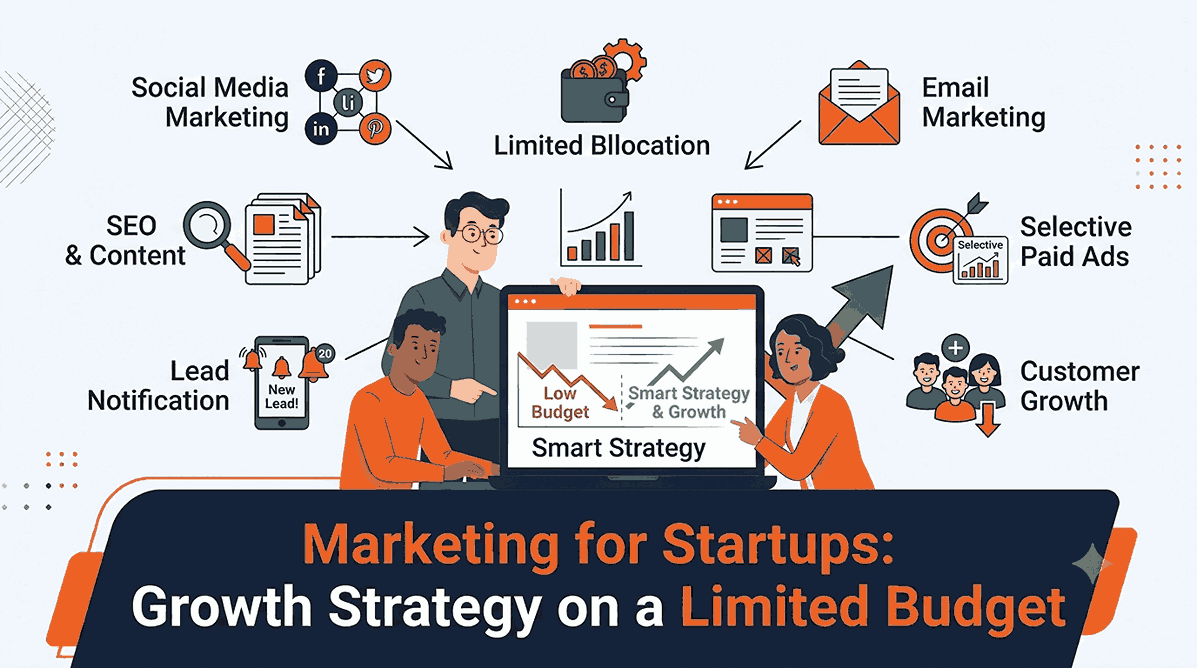
Most founders run into the same wall within the first year. A great product doesn't sell itself, and without a plan sitting behind it, even a strong idea stays invisible in a crowded market. Getting marketing for startups right early tends to decide whether a company reaches its next funding round or quietly runs out of runway first.
Here's the part that surprises people, though. A tight budget doesn't have to mean weak results. Founders spending a fraction of what larger competitors spend routinely outperform them, mostly by building a sharper, more deliberate startup marketing strategy instead of spreading thin resources across every channel at once.
Why Budget Constraints Force Better Decisions
A limited budget can actually work in a founder's favor, oddly enough. Larger companies waste a lot of spend on channels that never get tested properly against real results. A startup rarely gets that luxury, and the pressure that comes with it usually leads to sharper thinking.
Early-stage companies tend to put a much bigger share of revenue into marketing than established businesses do, sometimes well past ten percent during aggressive growth phases, compared to a far smaller slice among mature competitors. That gap exists because startups don't have the brand recognition or existing customer base a larger company already has going for it. Every dollar has to work harder as a result, which is exactly why a disciplined startup marketing strategy counts for more here than it would at a company with cash to spare for trial and error.
Setting Realistic Expectations Around Spend
One thing founders get wrong more often than not is how much marketing should cost relative to revenue at a given stage. Seed-stage companies usually run on fairly modest annual marketing budgets, somewhere between fifty thousand and a few hundred thousand dollars depending on the market, and that has to stretch across everything from brand development to the first real customer acquisition tests.
A few things worth accepting early on:
- Spending less than a competitor doesn't automatically mean growing slower, as long as the spend is aimed well.
- Marketing works better treated as an investment with a measurable return, not a fixed cost to squeeze down at every turn.
- Cutting corners in the wrong place, skipping proper website conversion work being a common one, often costs more in lost revenue than whatever got saved.
Building a Startup Marketing Plan From Scratch
A workable startup marketing plan doesn't need to be complicated. It needs to be specific enough that decisions stop getting debated endlessly and just get made.
- Nail down a narrow target customer profile before picking any channel or message.
- Set one or two measurable goals per quarter rather than a long wish list of objectives.
- Choose channels based on where the target customer already spends time, not wherever competitors happen to show up.
- Build in a review point every four to six weeks so what isn't working gets cut early.
This kind of structure keeps a small team from spreading itself too thin, which is one of the more common reasons early marketing spend never produces much.
Also read the related article: What Are the Most Effective Digital Marketing Strategies?
Choosing a Startup Growth Strategy That Fits the Budget
Not every startup growth strategy fits every company. A consumer app chasing fast user growth needs a different playbook than a B2B software company selling into a longer, more considered purchase cycle.
Content and Organic Channels
Content and search optimization tend to deliver some of the strongest long-term returns available to a small, resource-constrained team, even though they take longer to show results than paid channels do. A startup willing to put real effort into a handful of genuinely useful pieces, built around actual customer questions, often finds the traffic and leads keep compounding for months after publication.
Paid Acquisition, Used Selectively
Paid channels still earn a place here, mainly for validating demand quickly. The trick is treating paid spend as a controlled experiment instead of a default setting. Small, tight-scoped tests show you which messages and audiences actually convert before you spend bigger budgets.
Community and Word of Mouth
Founders tend to underestimate how much traction comes from direct engagement with early users, whether that's showing up in niche online communities, building a founder-led social presence, or just asking happy customers for a referral. These channels cost time instead of money, which makes them worth a lot more in the earliest stages than most people give them credit for.
Digital Marketing for Startups: Where to Focus First
Digital marketing for startups works best when it stays narrow at first and only expands once something is proven to convert.
- Build a simple, fast website centered on one clear action, instead of a sprawling site trying to do everything at once.
- Use email early. It's still one of the highest-return channels around, even with a very small list.
- Pick one or two social platforms where the target audience is genuinely active, rather than keeping a weak presence spread across five.
- Track a small set of core metrics consistently rather than a dashboard full of numbers nobody actually looks at.
That kind of focus lets a small team execute well on a few channels instead of executing poorly across many.
Also read the related article: How Delhi Businesses Are Scaling Faster with Digital Marketing in 2026
Marketing Strategy for Startups by Funding Stage
A marketing strategy for startups should shift as the company matures. What works at the earliest stage rarely matches what works once real funding is in place.
- Pre-seed and seed stage: lean on direct customer conversations, lightweight content, and organic community building over paid spend.
- Early growth stage: start testing paid acquisition in small, measured increments while still building out organic assets.
- Scaling stage: put more into channels already proven to convert, while setting aside a portion of budget for new experiments.
Skipping stages, jumping straight into heavy paid spend before any organic foundation exists being the most common version, is one of the easier ways early marketing budgets get wasted. A company that raises a bigger round often feels pressure to spend fast, but a rushed startup marketing plan put together without any prior testing tends to burn cash faster than it builds anything sustainable.
When to Bring in a Startup Marketing Agency
Not every early-stage company needs to build a marketing function entirely in-house. A startup marketing agency can make sense when a specific skill set is missing internally, particularly for technical work like search optimization or paid media management, both of which have a steep learning curve.
That said, an agency tends to work best as a complement to internal strategy, not a stand-in for it. When founders give up control of the campaign altogether, without being intimately involved in messaging and customer insight themselves, campaigns often drift away from what really resonates with their audience.
A few questions worth asking before bringing on a startup marketing agency:
- Have they worked with companies at a similar stage and budget before?
- Do they report on outcomes tied to revenue, not just impressions or reach?
- Is there an actual plan for knowledge transfer, so capability builds internally over time rather than staying locked with the agency?
Common Budget Mistakes Worth Avoiding
A handful of repeat mistakes account for a large chunk of wasted early marketing spend.
- Spreading a small budget across too many channels instead of concentrating on what's actually working.
- Chasing vanity metrics like impressions and followers instead of outcomes that connect to revenue.
- Putting heavy money into paid advertising before the messaging has even been validated organically.
- Ignoring existing customers in favor of nonstop new acquisition spend, even though retention is usually far cheaper.
Measuring What Actually Matters
A resource-constrained team can't afford to track everything, so whatever metrics get chosen need to tie directly back to growth. Customer acquisition cost, payback period, and retention rate matter a lot more at this stage than broad brand awareness numbers ever will.
Founders who check these numbers regularly, and are willing to cut spend on underperforming channels quickly rather than waiting it out, tend to stretch a limited budget considerably further than those who set a plan and only revisit it once a quarter.
Conclusion
A limited budget doesn't have to limit growth. What it demands is discipline: a clear startup marketing plan, a willingness to say no to channels that don't fit, and steady measurement of what's actually working. Founders treating marketing for startups as a deliberate, iterative process, rather than a scramble to be everywhere at once, tend to build the kind of growth that survives well past the first funding round.


