A 60-second video script can look short, but fitting the right message in one minute requires a very careful plan. It doesn’t matter if you are creating a social media reel, product video, explainer, advertisement, educational clip, or brand introduction; the script needs to be straight, engaging, and easy to understand.
One of the most common questions in video script writing is: How many words should a 60-second video script contain? The answer depends on your speaking speed, pauses, visuals, tone, and the type of content you are creating.
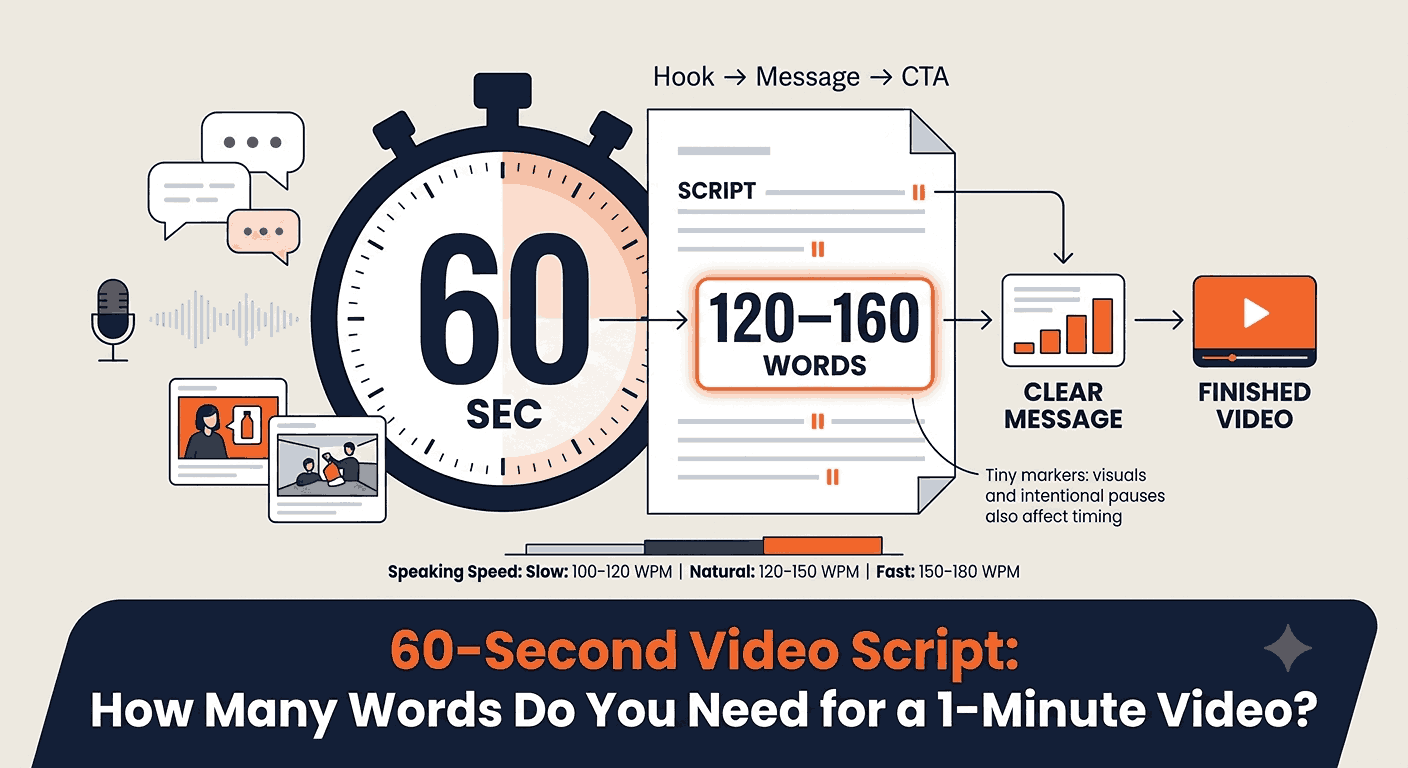
For most videos, a 1-minute video script generally has around 120 to 160 words when it is delivered at a normal speaking pace. However, a fast-paced promotional video may contain more words, while an emotional or cinematic video may need fewer words.
How Many Words for a 60-Second Video?
On average, people generally speak approximately 120-160 words per minute when delivering the content clearly. Therefore, a standard 60-second video script usually falls within this range only.
| Speaking Style | Approx. words per minute |
| Slow and conversational | 100-120 |
| Natural speaking | 120-150 |
| Professional presentation | 130-160 |
| Fast-paced social media | 150-180 |
| Very fast narration | 180+ |
For most brands, 130-150 words is a comfortable target for a 60-second video.
However, the word count should never be the only consideration. A script is designed to work with the visuals, music, captions, transitions, and pauses. If the narrator speaks too quickly just to fit more information, viewers can struggle to understand and follow the message.
Why Does Video Script Word Count Matter?
The video script word count directly affects the speed and the structure of your video. A script that is too long can make the narrator rush through the content. A script that is too short may leave unnecessary gaps or make the video feel incomplete.
Getting the word count right helps you in:
- You can maintain a natural speaking pace
- You should keep the video within 60 seconds
- Make the message easier to understand
- Plan visuals and transitions
- Create accurate voiceovers
- Improve viewer engagement
- Avoid unnecessary information
For short content, every second matters. Instead of just trying to communicate everything about a product or topic, you can focus on one clear message.
Also read the related article: Short-Form Video Advertising 2026: Why It's Still the Fastest Way to Build Trust and Leads
What Is the Ideal 60-Second Video Script Word Count?
There is no universal word count that can work for every video. The ideal length depends on the video's purpose and delivery style.
For example, an educational video may require a slow pace because the audience needs time to understand the new information. A social media advertisement, on the other hand, may use some quick sentences, energetic delivery, and rapid visual changes.
A useful starting point can be 140 words for 60 seconds. You can adjust the script after recording the voiceover.
If your 140-word script takes 70 seconds or more to read naturally, then you should remove some unnecessary phrases. If it takes only 45-50 seconds, then you can add some useful context, a stronger example, or a call to action.
How to Structure a 1-Minute Video Script
A strong 1-minute video script should have a clear beginning, middle, and ending. Since you only have 60 seconds, you should avoid lengthy introductions.
A simple structure can look like the following:
1. Hook: 0-5 Seconds
The opening of the video should immediately capture the attention.
You can start with:
- A question
- A surprising fact
- A common problem
- A bold statement
- A relatable situation
For example:
"Your videos are getting views-but why are they not generating customers?"
The goal is to make the viewers want to continue watching.
2. Problem or Context: 5-15 Seconds
You should explain what the audience is experiencing. Keep this section short and relatable. For example, if you are promoting video editing services, you could explain how poorly edited videos can lose viewers within the first few seconds.
3. Main Message: 15-45 Seconds
This is where you should provide the most valuable information of your content. You can explain the solution to the problem, benefit, process, product, or key takeaway. Avoid covering multiple unrelated ideas.
A 60-second video works best when it focuses on one primary message.
4. Call to Action: 45-60 Seconds
You should end the video with a clear next step. It can depend on your objective; the CTA could be:
"Book a consultation today."
"Follow us for more marketing tips."
"Visit our website to learn more."
"Try it today."
A strong ending tells the viewers what they should do next.
Also read the related article: Best Video Editing Service Provider in Delhi NCR
How to Calculate the Word Count for a 60-Second Video
You can estimate your required video script word count using a simple formula:
Words per minute × Video duration in minutes = Approximate word count
For example:
If the narrator speaks at 150 words per minute:
150 × 1 = 150 words
Therefore, a 60-second video would require around 150 spoken words.
For a 30-second video:
150 × 0.5 = 75 words
For a 90-second video:
150 × 1.5 = 225 words
This calculation gives you a starting point, but you should always test the script by reading it aloud.
Does Speaking Speed Change the Word Count?
Yes, for sure. The speed of speaking is one of the biggest factors that affect how many words you need for a 60-second video.
A fast narrator can deliver more than 160 words in a minute, while a slow narrator may comfortably deliver only 100-120 words. However, fast is not always better.
When viewers are watching an educational, technical, or instructional video, clarity is more important than speed. Giving viewers enough time to process the information can make the video more effective. For advertisements and social media content, a faster pace may work well, particularly when it is combined with short sentences and dynamic visuals.
How Visuals Affect Video Script Writing
A video script is not always made up entirely of spoken dialogue. A 60-second video may include the following:
- Voiceover
- On-screen text
- Product shots
- B-roll
- Animation
- Screen recordings
- Interviews
- Music
- Sound effects
This means that you don't necessarily need to speak 140 words.
For example, a product video may show the product while the narrator says only a few words. The visuals may communicate the additional information without adding to the spoken video script word count.
This is particularly important for short-form video content. Instead of explaining every detail verbally, you can use visuals to demonstrate what you mean.
Example of a 60-Second Video Script
Here is a simple example of a 60-second video script for a digital marketing company:
Hook:
"Posting regularly but still not getting enough customers?"
Problem:
"The problem may not be how often you post. It can be your strategy. Random content may get you views, but it doesn't always move people towards a purchase."
Solution:
"A better approach starts by understanding your audience, creating the content around their problems, and using every video with a clear purpose. Your hook should be to grab attention, your message should provide value, and your ending should tell the viewers what to do next."
CTA:
"Want your videos to do more than just get you views? Then start creating the content with a strategy behind every post."
The exact duration will depend on the speed of the narrator's delivery and pauses, but this illustrates how a short script can move from a hook to a problem, solution, and CTA.
Tips for Writing a Better 60-Second Video Script
Start With One Objective
Before writing the script, decide what you want the viewer to do or understand after watching your video.
Do you want to generate leads, explain the product, educate the viewers, increase awareness, or drive sales? One clear objective makes your video script writing much easier.
Write for the Ear, Not the Eye
A script is meant to be heard. Use short sentences and conversational language. Avoid complicated words and long sentences that may sound unnatural when spoken.
Instead of this sentence:
"Our organization provides a comprehensive solution that is designed to help in the optimization of the performance of marketing."
You can say:
"We help businesses improve their marketing performance." The second version is easier to understand and can sound more natural.
Keep the Introduction Short
Do not spend more than 10 seconds introducing your company. The viewers usually care more about what you can offer them than who you are.
Start with their problem, question, or interest.
Remove Filler Words
During the editing, you can remove unnecessary words such as:
- Basically
- Actually
- At this point
- Very
- Really
- To
Replacing wordy phrases with concise alternatives helps you maintain a strong pace.
Read the Script Out Loud
One of the simplest ways to check a script is to read it aloud while timing yourself. Don't simply count the words. Listen for:
- Awkward sentences
- Difficult pronunciations
- Unnatural pauses
- Rushed sections
- Repeated ideas
If the script feels difficult for you to say, it will probably feel difficult to hear too.
60-Second Video Scripts for Social Media
A Short-form video has become an important format for brands, creators, and businesses. Social media platforms such as Instagram, YouTube, and other social channels encourage you to brief the content that communicates the value quickly.
A 60-second format gives creators enough time to make a problem, provide useful information, and deliver a CTA without becoming too lengthy. However, successful short-form content is not just simply about making a long video short. It requires a different approach.
The first few seconds of the video should create curiosity. The middle should deliver the value quickly. The ending should provide you a reason to continue engaging with the brand or the content.
Common Mistakes in 60-Second Video Script Writing
Several mistakes can reduce the effectiveness of a one-minute video.
Trying to say too much: Covering the five different topics can make the message more confusing.
Ignoring the hook: A weak opening can cause the viewers to scroll away.
Writing like an article: Spoken content should sound natural rather than just formal and complicated.
Forgetting visuals: A video is a visual medium. The script should work with what the viewers see.
Using a weak CTA: If the viewers don't know what to do next, then the video may lose its marketing value.
Not timing the script: A word count cannot replace an actual read-through.
Conclusion
A 60-second video script generally has around 120-160 words, with approximately 140 words being a useful starting point for natural delivery. But the ideal video script word count depends on your speaking speed, pauses, visuals, content type, and audience.
Effective video script writing isn't just about filling every second with words. It's about delivering one clear message in a way that keeps viewers interested.
FAQS
Q1. How many words should a 60-second video have?
A 60-second video should generally need to have 120-160 words. It depends on the speaking speed, pauses, visuals, and content style. For a natural delivery, around 140 words is a good target.
Q2. How many words can you speak in one minute?
Most people can easily speak 120-160 words per minute. Some fast speakers can reach around 180 words, while some slow speakers reach around 100-120 words.
Q3. How many words is a 1-minute voiceover?
A one-minute voiceover mainly has 120-160 words. For a clear, professional voiceover, around 130-150 words can usually provide enough room for natural pauses and easy understanding by the audience.
Q4. What is the average speaking speed for video?
The average speaking speed for video content is around 130-160 words per minute. Educational or professional videos may use a slow pace, while energetic social media videos can be considerably faster.
Q5. How long should a video script be?
A video script should match the time and pace of the speaking. For a 1-minute video, 120-160 words is generally nice; with shorter scripts, you can allow more pauses and storytelling visually.


