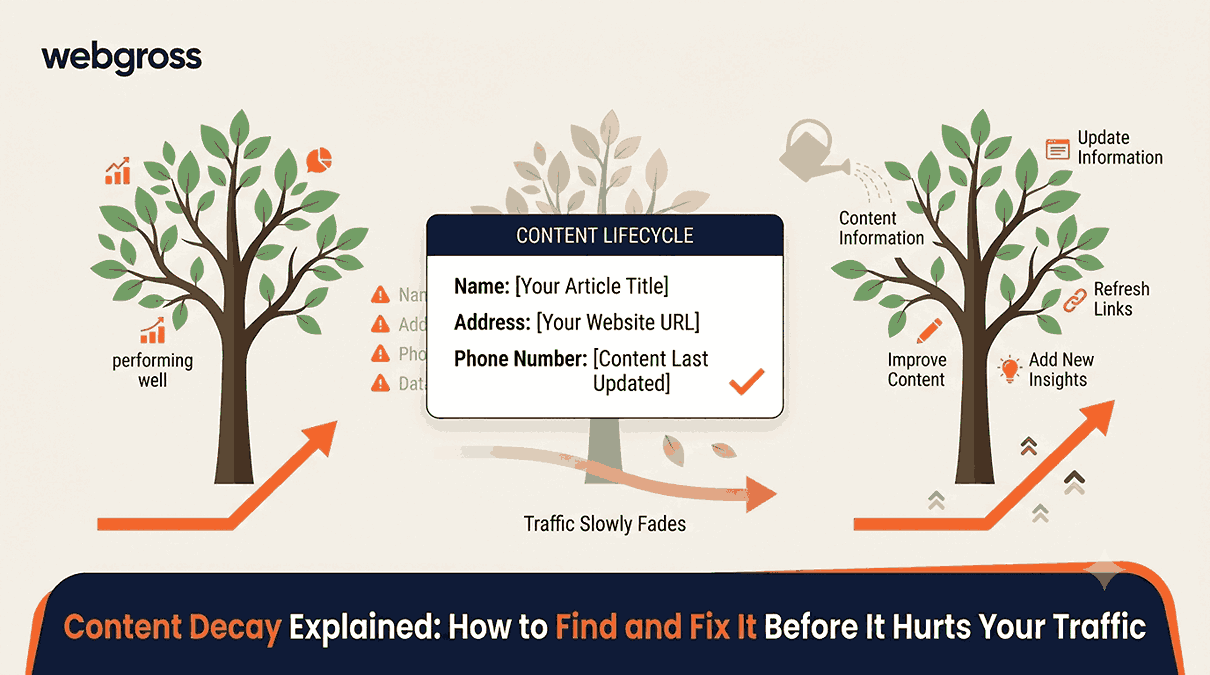
Publish once, walk away. That approach held up reasonably well for years. It does not hold up now. AI systems retrain on a rolling basis, and the sources they judge worthy of citation shift along with each update. A page cited confidently six months ago can fall out of favor entirely, with nothing on the page itself ever having changed.
A deliberate content refresh strategy has, as a result, moved from a background task to something closer to core infrastructure, even though many organizations still treat it as an afterthought. Earning a citation once is not the finish line it once resembled. Holding onto that citation as models retrain, and as expectations shift beneath a page without warning, is the considerably harder problem.
Why Content Decays Faster in AI Search
Traditional search let a well-built page coast on its position for a long stretch, sometimes years, before anyone needed to touch it. AI-generated answers do not extend that same patience. Studies examining what AI assistants actually cite have found these sources trending noticeably newer, by roughly a quarter or more in some analyses, than pages holding comparable spots in ordinary organic results.
- AI systems are built to favor content reflecting current facts, since citing something outdated puts the platform's own credibility on the line.
- Fast-moving subjects fall into what some researchers now call a decay window, usually around ninety days, after which retrieval systems start reaching for newer alternatives instead.
- A large share of pages earning AI citations today were updated sometime in the past year. Static, untouched pages appear to be losing relevance quietly, even where nothing about their accuracy has actually changed.
Generative Engine Optimization (GEO) vs Answer Engine Optimization (AEO): What Each Actually Means
People use these two terms interchangeably as though they mean the same thing, when they don’t. Generative Engine Optimization (GEO) is the broader discipline: shaping content and brand presence so that AI systems, conversational assistants included, choose to cite and recommend a given source. Answer Engine Optimization (AEO) sits underneath that, more narrowly focused on formatting content so a model can lift it cleanly as a direct answer, usually through compact, well-labeled sections built for extraction.
Most teams end up needing both running side by side. AEO decides whether one specific passage gets pulled correctly. GEO builds the wider authority and structure that makes an entire domain worth citing in the first place. Neither one replaces standard SEO work. Both simply carry that work into a newer environment.
Also read the related article: Why High-Quality Content Matters in Digital Marketing in 2026
Building a Content Refresh Strategy That Keeps Pace
Audit First, Rewrite Second
Most pages do not actually need a ground-up rebuild. Treating every refresh as a full rewrite wastes time on pages that only needed a narrow, targeted fix. A better starting point: audit existing pages against a short list of concrete signals, outdated statistics, missing FAQ sections, thin subheadings, no structured data.
Pages already carrying strong backlinks or a solid ranking history, but earning zero AI citations right now, tend to be the best refresh candidates. The authority is already there. It just needs to be made legible to newer retrieval systems.
Resource Allocation: Refresh vs New
A frequent mistake: pouring most of the content budget into new articles while established, high-authority pages quietly go stale in the background. A steadier approach leans toward refreshing what already exists, since updating an established page generally takes considerably less editorial effort than building something new, and often recovers citation visibility faster too.
A reasonable split for most teams looks something like this:
- Most of the content budget goes toward refreshing established, high-authority pages with updated data, added depth, and proper schema.
- A smaller slice stays reserved for genuinely new topics that no existing page could reasonably be stretched to cover.
Also read the related article: 10 Content Marketing Trends Every Brand Should Follow in 2026
AI Content Optimization Techniques That Extend Citation Life
Real AI content optimization takes more than swapping in a newer statistic and republishing under a fresh date. Retrieval models can increasingly tell the difference between a surface-level edit and something genuinely deeper, and that difference matters for citation eligibility.
- Bring in new subtopics or angles that reflect how a query's intent has actually shifted, not just updated numbers sitting inside the same old framing.
- Widen structured data coverage, FAQ and article schema especially, since machine-readable markup keeps proving to be one of the more reliable citation signals available.
- Reinforce authorship and expertise signals, verifiable credentials and first-party data among them, since AI systems weigh trustworthiness heavily when picking what to cite.
- Break long paragraphs into short, extractable answers near the top of each section rather than letting them sit buried under supporting detail.
Also read the related article: How to Write Content That Ranks in Google and AI Search
SEO Content Updates Worth Prioritizing Each Quarter
Not everything needs the same refresh schedule. SEO content updates should track how fast a given topic actually moves, rather than one blanket rule stretched across an entire site.
- Time-sensitive categories, pricing, product features, regulatory information, generally need review every six to nine months at minimum, sometimes quarterly if the subject moves particularly fast.
- Evergreen educational content can go longer between touches, though even these pages benefit from an occasional look, since the intent behind a seemingly stable topic can still drift over time.
- High-traffic or high-conversion pages deserve first priority in any refresh schedule, since keeping these current pays off more than similar effort spent on lower-value pages.
Also read the related article: SEO Content Writing Guide
Tracking AI Citations Over Time
A content refresh strategy only earns its keep if someone can actually see whether it's working. Tracking AI citations needs a different toolset than ordinary rank tracking, since standard analytics rarely show whether a page got referenced inside an AI-generated answer at all.
A few practical ways to track this:
- Filter referral traffic in analytics platforms to isolate visits coming from known AI assistant sources.
- Manually run target queries across major AI platforms on a set schedule to see whether a brand or page turns up in the response.
- Use dedicated AI visibility monitoring tools built to track citation frequency across several assistants at once.
Traffic that arrives through an AI citation tends to convert at a noticeably higher rate than typical organic traffic, which makes this tracking worth the extra effort rather than a nice-to-have bolted onto existing reporting. Anyone serious about AI Search optimization needs this visibility layer in place before deciding where refresh effort actually pays off.
Also read the related article: AI Writing vs Human Writing (2026)
Content Optimization Checklist Before Republishing
Before a revised page goes live, running it through a quick content optimization checklist helps confirm the update actually carries enough weight to matter, rather than a cosmetic pass that changes little underneath.
- Has genuinely new information gone in, beyond a rewritten intro or an updated publish date?
- Does the page carry current, verifiable statistics instead of numbers carried over untouched from the original?
- Is structured data present and accurate, reflecting whatever changed during the update?
- Does the page answer the query the way it's actually being asked today, not how it was framed back when the page first went up?
Building a Content Refresh Strategy for AI Search Into Your Calendar
Teams getting the best results treat this as a recurring rhythm, not a one-off project. A working content refresh strategy for AI search lives directly inside an editorial calendar, with specific pages flagged for review on a set schedule rather than waiting for a visible drop in visibility before anyone acts.
A simple structure to start with:
- Run a baseline audit to see which existing pages already earn AI citations, and which have strong authority but none at all.
- Set a review cadence by content category, giving time-sensitive and high-value pages priority first.
- Track citation appearances alongside traditional rankings so both numbers feed into the same refresh calendar.
- Revisit the whole process every quarter, since what counts as a meaningful update keeps shifting as the underlying models keep changing.
Turn Your Existing Content Into a Long Term SEO Asset
Your older pages have something your new pages don’t: backlinks, ranking history, and trust built over time. Instead of ignoring them, a refresh can turn these pages into something that brings traffic and AI citation for years. This means that old stats will be updated, FAQs and schema will be added and sections are changed so they answer today’s question clearly. With the right content writing services, you don’t have to start from scratch every time. You improve what you have already built and get stronger with each update.
Why Choose Us for Content Writing?
Keeping your content authentic and fresh for AI search takes time, research and a solid plan. Webgross is a trusted content writing company in Delhi, helps you with all of this. Our writers write content after researching every topic thoroughly and using the right keywords which makes it easy to read for both people and AI tools. Every piece is checked for plagiarism before delivering. Partner with Webgross to keep your content working for you regardless of how AI search changes.
Also read the related article: Perfect Sign of Best Content Writing Company
Conclusion
Earning an AI citation once was never going to be enough on its own, and treating it as a done deal tends to show up later as a slow, quiet slide in visibility. AI Search optimization now leans on ongoing maintenance just as much as it leans on original content creation. Organizations that build a disciplined refresh rhythm into how they manage what already exists, rather than letting strong pages quietly age out of relevance, are the ones staying visible as the models underneath keep changing.


