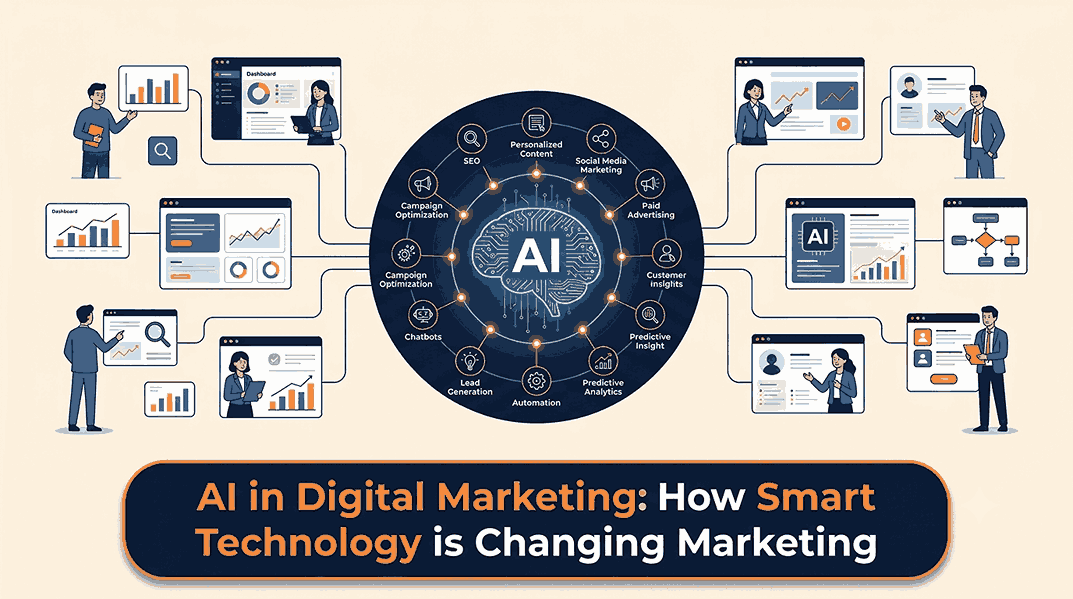
Artificial intelligence has transformed the way businesses now connect with customers. From personalized recommendations to automated campaigns, AI in digital marketing is helping brands make faster decisions, improve customer experiences, and increase return on investment (ROI).
Instead of relying only on guesswork, now marketers use AI to analyze customer behavior, predict new trends, automate repetitive tasks, and deliver highly targeted campaigns. It does not matter if you're a startup or an established business; understanding how AI is changing digital marketing will always help you stay competitive in today's fast-moving online/digital world.
In this blog, you will learn about artificial intelligence in marketing, its benefits, practical applications, and how businesses can use AI to achieve better results in marketing.
What is AI in Digital Marketing?
AI in digital marketing refers to the use of artificial intelligence technologies such as machine learning, natural language processing (NLP), predictive analytics, and automation to improve marketing strategies and customer engagement.
Rather than just replacing marketers, AI enhances their abilities by handling the data-heavy tasks, identifying patterns, and providing actionable insights that would take hours or even days.
Modern AI marketing tools help businesses by:
- Analyze customer behavior
- Automate repetitive marketing tasks
- Personalize user experiences
- Improve advertising performance
- Generate marketing content
- Predict customer actions
- Optimize conversions
Also read reated article: What Is Digital Marketing? Why it is so Hyped?
How AI is Changing Digital Marketing
The biggest impact of AI is its ability to make marketing smarter rather than just simply faster.
Better Customer Understanding
AI collects and analyzes customer data from websites, emails, social media, and purchase history to understand customer interests and buying behavior. This helps businesses create highly personalized campaigns that will increase engagement and sales.
Personalized Marketing Experiences
Today's consumers expect a personalized experience. AI enables marketers to:
· Recommend products based on browsing history
· Personalize email campaigns
· Display relevant website content
· Customize offers for different customer segments
This high level of personalization improves customer satisfaction and conversion rates.
Smarter Advertising
AI platforms automatically optimize advertising campaigns by:
· Identifying high-performing audiences
· Adjusting bids
· Selecting the best creatives
· Improving ad placements
Businesses spend less while achieving better results.
Faster Content Creation
AI assists marketers by generating:
· Blog outlines
· Social media captions
· Email campaigns
· Product descriptions
· Video scripts
While human editing remains important, AI has significantly sped up content production.
Improved Customer Support
AI-powered chatbots provide instant customer support 24/7 by answering common questions, recommending products, and guiding users through the buying process. This improves the customer experience while reducing support costs.
Also read the related article: How to grow your business with digital marketing?
Artificial Intelligence in Marketing Across Different Channels
AI for SEO
Artificial intelligence helps marketers by providing:
- Discover keyword opportunities
- Analyze competitors
- Optimize website content
- Improve search rankings
- Predict search intent
AI also helps websites adapt to Google's evolving search algorithms.
AI for Social Media Marketing
Social media platforms create a massive amount of user data.
AI helps marketers by:
- Scheduling posts at the right times
- Analyze audience engagement
- Monitor brand mentions
- Generate content ideas
- Identify trending topics
This creates better engagement and stronger brand visibility.
AI for Email Marketing
AI improves email marketing by:
- Personalizing subject lines
- Predicting open rates
- Optimizing send times
- Segmenting subscribers
- Recommending products
Businesses can improve email performance without manually managing every single campaign.
AI for PPC Advertising
Paid advertising becomes even more efficient with AI through:
- Automated bidding
- Budget optimization
- Audience targeting
- Ad testing
- Performance prediction
AI helps marketers maximize ROI while reducing wasted ad spend.
AI for Content Marketing
AI supports content marketers by:
- Identifying trending topics
- Generating content briefs
- Optimizing readability
- Improving keyword usage
- Suggesting internal linking opportunities
The result is high-quality content that is produced more efficiently.
Also read the related article: AI Writing vs Human Writing (2026)
Benefits of AI in Digital Marketing
There are many benefits of AI in digital marketing that make it an essential tool for modern businesses.
Saves Time
AI automates repetitive tasks such as:
- Email scheduling
- Data analysis
- Social media posting
- Campaign monitoring
Marketing teams can focus on strategy instead of manual work.
Better Decision Making
AI analyzes fraud datasets within seconds, helping marketers make data-driven decisions rather than relying only on assumptions.
Higher ROI
AI improves campaign targeting and optimization, helping businesses generate more conversions while lowering marketing costs.
Enhanced Customer Experience
Personalized recommendations and faster customer support create a better user experience and increase customer loyalty and retention.
Improved Lead Generation
AI identifies high-intent users and predicts which prospects are the most likely to convert; it helps sales teams prioritize quality leads.
Real-Time Optimization
Unlike traditional marketing methods, AI continuously monitors campaigns and makes adjustments based on live performance data.
Also read related article: Top 5 Tips To Increase ROI With Marketing Analytics
How Businesses Use AI in Digital Marketing
Businesses across all industries are integrating AI into their daily marketing operations. Here are some common examples of how businesses use AI in digital marketing:
Ecommerce
- Product recommendations
- Dynamic pricing
- Personalized shopping experiences
- Cart abandonment emails
Healthcare
- Appointment reminders
- Patient engagement
- Personalized healthcare campaigns
- Automated support
Real Estate
- Lead scoring
- Virtual assistants
- Personalized property recommendations
- Automated follow-ups
Education
- Student engagement
- Personalized course recommendations
- Email automation
- Admission marketing
Financial Services
- Customer segmentation
- Fraud detection
- Personalized financial products
- AI-powered customer service
How AI Helps Digital Marketing Teams
Many marketers wonder how AI helps digital marketing professionals in their daily work. AI acts as an intelligent assistant that handles repetitive and data-intensive tasks while also providing valuable insights.
Marketing teams use AI for:
- Audience research
- Customer segmentation
- Campaign automation
- Predictive analytics
- Content optimization
- Performance reporting
- Competitor analysis
- Marketing attribution
Rather than replacing marketers, AI also allows them to spend more time on creativity, branding, and strategic planning.
How to Use AI for Digital Marketing
Businesses that want to adopt AI should start slowly and gradually. Here's how to use AI for digital marketing effectively:
Define Marketing Goals
You should start by identifying your objectives:
- Generate leads
- Increase sales
- Improve engagement
- Reduce marketing costs
- Boost website traffic
Collect Quality Data
AI performs perfectly with the correct customer data. You can ensure that your CRM, website analytics, and marketing platforms are properly managed.
Automate Repetitive Tasks
You should use AI to automate the:
· Email campaigns
· Social media scheduling
· Customer support
· Lead nurturing
· Reporting
Personalize Customer Experiences
You can personalize customer experiences as AI delivers:
· Product recommendations
· Personalized emails
· Dynamic website content
· Targeted advertisements
Monitor Performance
You can regularly review AI-generated insights and combine them with human expertise to refine campaigns and improve results.
Also read the related article: AI in Digital Marketing: How Webgross Uses AI to Drive Better Results
Challenges of AI Marketing
While AI offers many advantages, businesses should also consider the challenges AI brings. Some common challenges are:
· Dependence on high-quality data
· Initial implementation costs
· Privacy and compliance concerns
· Need for human creativity and oversight
· Continuous monitoring and optimization
The most successful marketing strategies combine AI efficiency with human judgment and creativity.
The Future of AI Marketing
The future of AI marketing is becoming intelligent and customer-focused. Emerging technologies will enable:
· Hyper-personalized customer journeys
· Voice and visual search optimization
· Predictive customer behavior analysis
· AI-generated video marketing
· Advanced conversational AI
· Smarter marketing automation
· Improved cross-channel campaign management
Businesses that adapt to AI early will be better positioned to respond to changing consumer expectations and digital trends.
Also read the related article: Six Main Pillars of Digital Marketing for Brand Success
Conclusion
AI in digital marketing is no longer a future concept, but it is transforming how businesses attract, engage, and retain customers today. From automation and personalization to predictive analytics and smarter advertising, artificial intelligence in marketing empowers businesses to make better decisions and achieve stronger results.
Understanding how AI is changing digital marketing and implementing the right AI-powered tools can help businesses improve efficiency, reduce costs, and increase ROI. As AI technology continues to evolve, organizations that embrace innovation while maintaining human creativity will build stronger customer relationships and gain a lasting competitive advantage.
Frequently Asked Questions
Q1. How can businesses use AI for marketing?
Businesses use AI for marketing by automating repetitive tasks, analyzing customer behaviour, personalizing content, improving email campaigns, optimizing advertising, generating content, predicting trends, and enhancing customer support through chatbots. AI helps in increasing efficiency, engagement, conversions, and overall marketing performance.
Q2. How is AI changing SEO in 2026?
AI is transforming SEO in 2026 by highlighting user intent, conversational search, AI Overviews, and content quality. Marketers now optimize for search engines and AI-powered platforms by using structured data, topical authority, semantic keywords, and valuable content.
Q3. Can AI replace digital marketers?
AI cannot completely replace digital marketers because it lacks human creativity, strategic thinking, emotional understanding, and brand storytelling. Instead, AI also works as a powerful assistant, helping marketers automate tasks, analyze data faster, and make better marketing decisions.
Q4. What are the risks of using AI in digital marketing?
AI in digital marketing comes with risks such as inaccurate content, repetitive messaging, or a lack of original information. Overdependence on AI can reduce brand authenticity, while privacy concerns, algorithmic bias, and excessive automation may negatively affect customer trust, engagement, and long-term marketing effectiveness.
Q5. How will AI shape the future of digital marketing?
AI will shape the future of digital marketing to be more personalized, predictive, and data-driven. Businesses will use AI for smarter customer targeting, real-time optimization, content creation, automation, and enhanced user experiences, enabling marketers to deliver better results with greater efficiency and accuracy.


