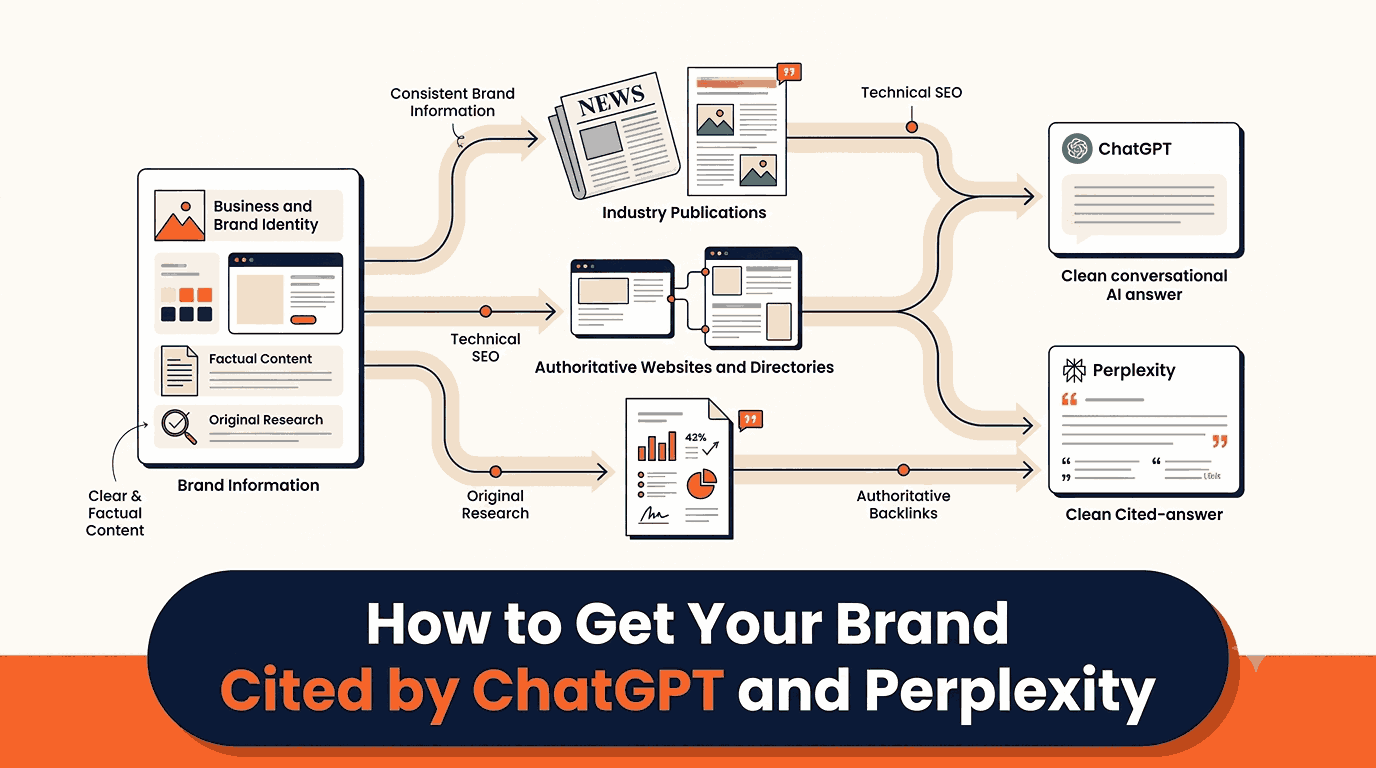
Something has changed in how people find information. Rather than typing a query into Google and clicking through to websites, a growing number of users now put their questions directly to AI systems and accept the answer they receive. ChatGPT and Perplexity are the two platforms driving most of that shift right now, and brands that are not thinking about how they appear in those responses are already a step behind.
The fundamentals are familiar. Authority, consistency, clarity, and relevance have always mattered in search. What has changed is how those signals are evaluated and surfaced. This is an AI search visibility guide for marketers, content teams, and business owners who want to approach that challenge practically.
How AI Answer Engines Actually Work
To understand how to get cited by ChatGPT and similar tools, it is useful to know what they are doing when they answer a question. ChatGPT draws primarily on training data, a large body of text collected from the internet at a specific point in time. When someone asks a question, it generates an answer based on patterns in that data. Brands that were referenced frequently and had strong documentation in reliable online sources before the model’s training cutoff are more likely to appear in model responses. To shape future training data, you need to exist, be cited, and be right in the sources those systems pull from.
Perplexity is different. It’s a real-time answer engine that pulls in live web content at the moment a query is made and cites those sources. This means Perplexity SEO is much more similar to classic search optimization than ChatGPT citation, though the underlying signals of authority and clarity apply to both.
What both systems resist is noise. Content that is vague, inconsistent, or primarily promotional does not serve the function these tools are trying to perform. They are trying to answer questions accurately, and they draw on sources that help them do that.
AI SEO vs Traditional SEO
AI SEO and Traditional SEO have similar bases but different goals. Here is how they compare:
| Factor | Traditional SEO | AI SEO |
Primary Goal | Rank pages for specific keywords in search results | Be cited as a credible source in AI-generated responses through AI SEO |
Content Focus | Keyword optimisation and search intent matching | Factual accuracy, depth, and content that is genuinely worth citing |
Content Type | Optimised blog posts, landing pages, product pages | Original research, authoritative guides, factual explainers |
Technical Requirements | Traditional SEO requires crawlability, page speed, and metadata for search engines. | AI SEO requires structured data and clean architecture, critical for Perplexity SEO and live retrieval |
Measurability | Tracked through rankings, traffic, and click-through data | Monitored through brand citation tracking and presence in AI responses, as covered in this AI search visibility guide |
The table above shows the core differences, but the underlying point is straightforward. Traditional SEO is something you can directly optimise for. AI SEO is something you have to earn over time by becoming a source that AI systems genuinely trust. The better your brand performs on credibility, consistency, and factual depth across the web, the stronger your chances of appearing in responses generated by tools like ChatGPT and Perplexity.
Practical Strategies for AI Search Visibility
Build Citable Content
- Generate original research, comprehensive guides, and data-driven analysis that AI systems can actually cite
- Generic or promotional content rarely gets cited. Factual, well-structured information does
Build a Presence Beyond Your Own Website
- Earn mentions from industry publications, news outlets, and authoritative directories
- Every credible third-party citation increases your footprint in the sources AI SEO systems learn from
Keep Information Consistent Everywhere
- Inconsistent brand names, descriptions, or contact details across platforms create uncertainty
- Audit your presence on your website, Google Business Profile, LinkedIn, and directories and make sure everything matches
Invest in Technical SEO
- For Perplexity SEO specifically, technical quality matters directly since the platform retrieves live content
- Use clear heading structures, descriptive metadata, fast page speeds, and schema markup where relevant
Write Clearly and Factually
- Answer questions directly, avoid vague claims, and organise content logically
- FAQ sections, step-by-step guides, and well-defined terminology are formats that AI SEO systems process and surface more readily
None of these steps guarantee citations, but together they make your brand a more credible and discoverable source for AI systems evaluating what to reference.
How to Improve Visibility for ChatGPT Specifically
Knowing how to get cited by ChatGPT means accepting a certain amount of indirect influence. You can’t directly influence the training data; brands can improve their chances of being included in future training updates by having a consistent, well-documented presence across the sources these systems are learning from.
The goal is to be a brand that is present often and correctly across the information ecosystem and not just within its own channels. This is accomplished by being referenced on Wikipedia, referenced in Industry publications, referenced in research settings, and being consistently present in authoritative directories.
How to Improve Visibility for Perplexity Specifically
Perplexity SEO is the more immediately actionable of the two platforms. Because Perplexity pulls live content at the moment a question is asked, the same factors that have always led to search visibility still hold: a strong backlink profile, a technically clean website, well-structured content, and consistent publishing.
What changes is the intent behind the content. Perplexity users ask direct, specific questions and expect direct answers. Content that gets to the point quickly and makes information easy to extract outperforms pieces that bury useful information several paragraphs in.
A practical starting point is to search the questions your target audience asks most often directly in Perplexity and look at what gets cited. If your brand has no content that could reasonably serve as a source, that is a gap worth filling. If relevant content exists but is not being surfaced, the issue is likely technical or a credibility signal problem rather than a content gap.
AI Search Visibility Checklist
This AI search visibility guide framework provides teams with a practical starting point:
- Check existing content for factual accuracy, clarity and organizational quality
- Identify gaps in your industry where topics are under-covered and fill them
- Earn citations from reliable third parties through digital PR and media outreach
- Keep brand information consistent on all online platforms and directories
- Publish original research or data that other publications are likely to cite
- Build a backlink profile of authoritative domains in your industry
- Review your presence on high-authority sites such as Wikipedia, LinkedIn, and relevant industry directories
No brand can guarantee that it will be cited by any AI system, including Perplexity or any other AI system. These tools decide for themselves what to surface, based on signals no single brand can fully control. What brands can do is become more worthy of citation, by becoming genuinely credible, well-documented, and consistently represented sources of information.
Also read the related article:
SEO Services in Delhi That Drive Real Business Growth
Top Reasons Why Seo is important for your business
Conclusion
The brands that earn consistent visibility in AI-generated responses are not necessarily the ones investing most heavily in advertising. They are the ones that have done the slower, more deliberate work of building genuine authority, maintaining accurate information across the web, and producing content that is actually worth drawing on.
AI SEO is not a shortcut. It is an extension of what credible brand building has always required. The difference is that the audience evaluating your credibility now includes systems that can process information at a rate no human reviewer could match. Meeting that standard means doing the fundamentals well and sustaining them consistently over time.


