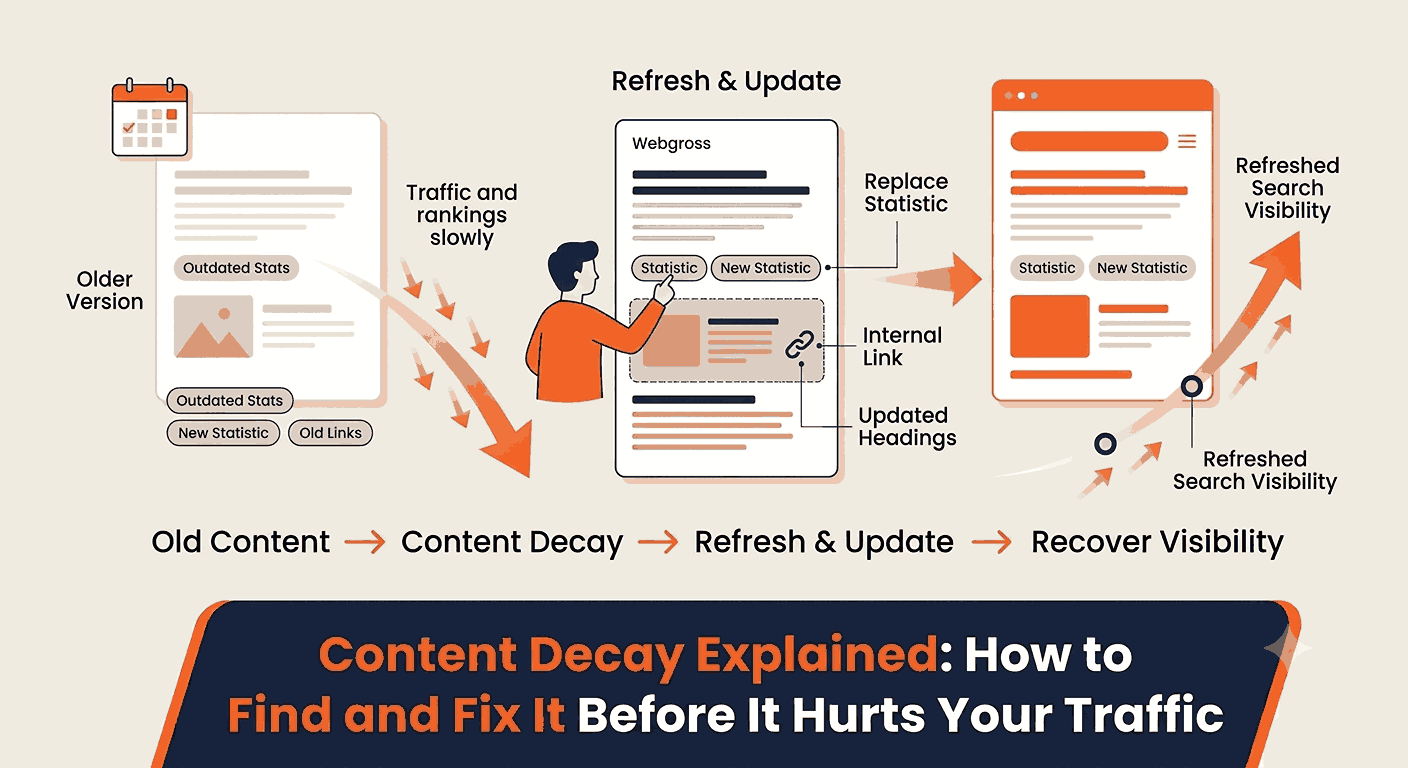
You post content, watch it rank really well, and get many clicks or visitors for months. Then, slowly and without any warning sign, you notice that the traffic is getting slower and there are fewer clicks than before. You didn’t change anything, but still the numbers keep decreasing every week until one day you notice that there are no clicks or visitors on your website.
This quiet decline is what Content Decay is. It is a very common problem that is ignored in SEO, mainly because it doesn't happen suddenly. It grows slowly, and most businesses notice it very late, when they have already lost so many clicks and sales that used to come from that page every month.
This article will tell you what content decay actually is, why it happens, and what practical steps you can take to catch it early and fix it before it does any real damage.
What Is Content Decay, Exactly?
Content decay refers to the drop in traffic and rankings of a page or a website, slowly over time, even without making any changes to the page. A blog post that was once ranked at the top might drop and eventually stop bringing any clicks or visitors at all.
This happens because the internet is updated regularly while your content stays the same. Competitors publish new articles, search engines update how they evaluate content quality, and outdated information needs to be updated. If you don’t make any changes to the page and keep it the same as it was on the first day, it will not perform well, and its ranking will slowly drop every month.
Also read the related article: 7 Easy Ways to Increase Website Traffic
Content Decay Explained Through a Simple Example
Here is content decay explained in an easy way. Imagine that you wrote a guide two years ago about the best tools that a person can use for a particular task. At that time, it was accurate and useful, so it brought many clicks and visitors for months.
Since then, many new tools have been launched, new features have been added to older tools, and pricing has also changed. There are more fresh and updated guides published by the competitors. If you don’t update your original page, it slowly looks less useful to both readers and search engines.
This did not happen suddenly. This change happens gradually, and the page that once performed really well may no longer show up at the top of the results page.
Also read the related article: Why High-Quality Content Matters in Digital Marketing in 2026
Why Content Decay SEO Problems Are Easy to Miss
Content decay in SEO is one of the biggest challenges because it is not visible as a major issue. Website traffic doesn’t fall in one night. It falls slowly each month, and at that moment, it is not identified as a big problem and is ignored.
Businesses notice after months that their page has lost most of its traffic. This is why you should update your page regularly rather than taking action after you have already lost the website traffic. You should track content decay regularly so that you can take corrective actions on time.
How to Spot Content Decay Before It Gets Worse
You should regularly review your published content to spot content decay early rather than only paying attention to newer content. There are a few things that can make this easier.
You should look at your analytics data and compare the traffic of each page for several months. If there is a steady decrease in traffic rather than a sudden one, it is a sign of content decay.
Check your ranking for the keywords you included on your page. If a page has lost its position from second position to tenth position, then it is a sign that you need to make changes in it.
Also, look at the pages that are ranking above your page. If your competitors have posted newer, more detailed, and updated content on the same topic recently, then that’s the reason why your rankings are coming down, even if you have changed nothing on your page.
Fixing Content Decay: Practical Steps That Work
Once you have identified a page that's falling in rankings, you don’t need to change the page completely. You can make changes to the page and update it to make it rank well.
Update outdated information. Update the numbers, pricing, and examples on your page. Even small updates can improve how your page is trusted by both the readers and the search engines. It is important to make updates, especially on pages where numbers or prices are the main reason people are visiting.
Expand thin sections. If your competitors are now covering those things that your original page didn’t have, then you should add that information to your page rather than ignoring it, because a reader will prefer a page that has all details and complete content.
Refresh the publish date. Once you have made changes to your page, you should also update the publish date. This shows that the content on your website is accurate and up to date, and it helps your website perform better.
Improve the structure. Both search engines and readers prefer clear headings, shorter paragraphs, and a proper table of contents on longer pages. If the structure of your page is not proper or is hard to follow, then you can structure it properly, as it will help your page to be visible.
Check and refresh internal links. Make sure the links on your page are updated and point to newer, more relevant pages. This helps your page to be connected to the rest of your website.
Building an SEO Content Strategy That Prevents Decay
Fixing pages one by one is good, but a stronger long-term approach is to include content decay checks directly into your regular SEO content strategy, rather than checking it once a year.
You can set a schedule for every three months to review your older pages that are performing really well and check whether something needs to be updated. First, review and update the pages that brought good traffic and leads, because these pages are the ones where it is worth spending more time to refresh.
It also helps you build a habit of SEO content optimization for the new content that you publish. You should also know whether the page is built to stay useful and relevant over time or will it need frequent updates just to stay relevant.
The Role of Evergreen Content in Reducing Decay
All content does not decay very quickly. Evergreen content is content that stays relevant and useful even if there are new trends, it does not decay quickly compared to content that includes specific tools, prices, or fast-moving trends.
This doesn't mean that you should not publish timely content, in fact, it brings good traffic in the short term. You should balance your content plan, it should include evergreen content that stays relevant and useful for many years, and time-sensitive content that is to be updated regularly.
Also read the related topic: SEO Content Writing Guide
Final Thoughts
Content Decay is a very normal thing for any website, and it does not mean that something is wrong with your website or page. It is very important that you catch this early and update it, rather than ignoring it.
If you review your content regularly and include both evergreen and time-sensitive content, it will help your pages perform well. Maintaining your page consistently is far better than changing it completely later.


